
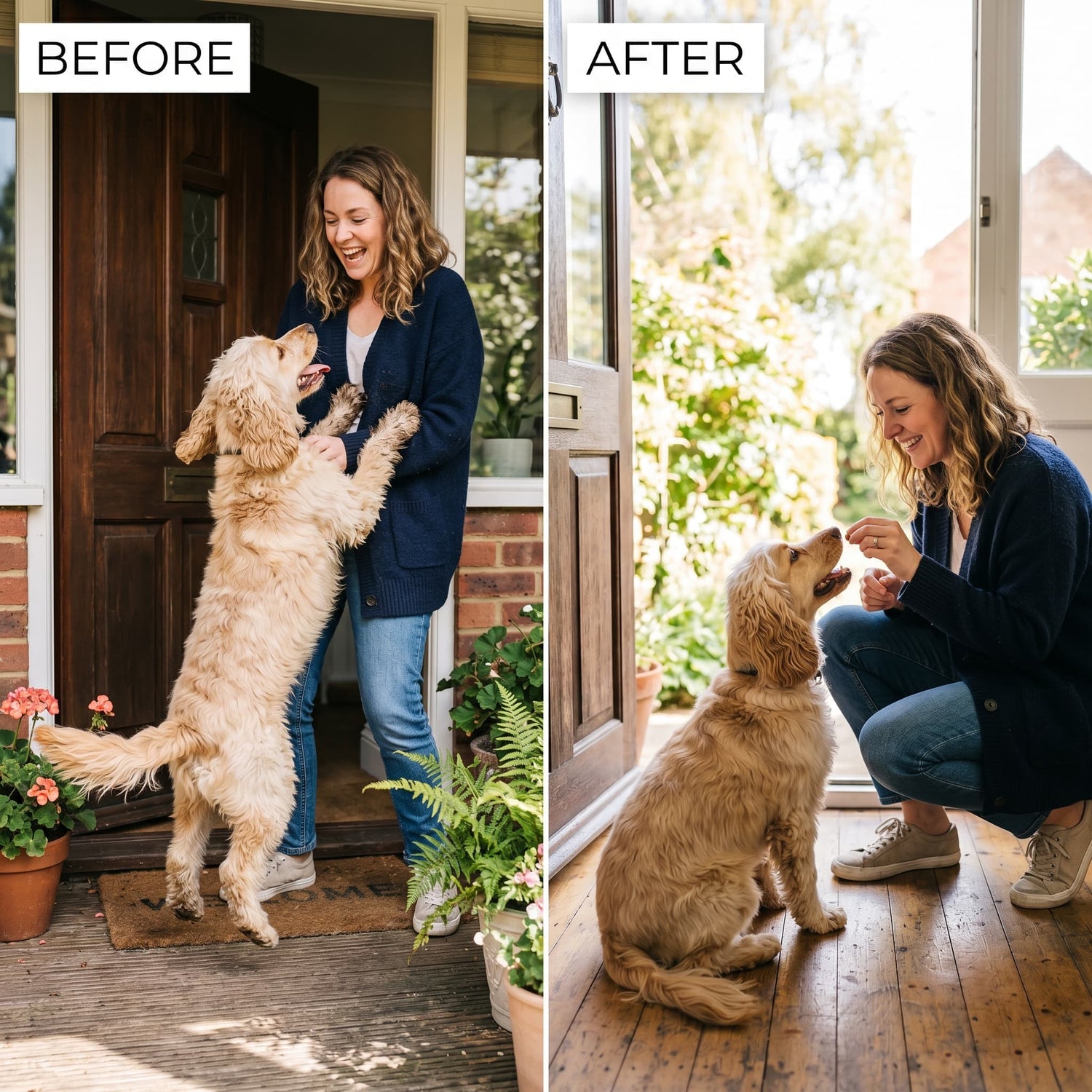
Does your dog launch themselves at every person they meet? You're not alone — jumping up is one of the most common dog behaviour problems in the UK. Here's exactly why they do it and how to stop it for good. 🐾
Why Do Dogs Jump Up on People?
Before we get into the solutions it helps to understand why dogs jump up in the first place — because the reason matters for choosing the right approach.
The answer is actually very simple. Jumping up works.
When your dog was a puppy they jumped up and people laughed, bent down to fuss them, said "aww" and gave them attention. The puppy learned a very clear lesson — jumping up gets me what I want. So they kept doing it.
It's not naughtiness. It's not dominance. It's not aggression. It's a dog doing exactly what they've been accidentally taught to do — because at some point, jumping up was rewarded.
The good news is that what has been learned can be unlearned. With the right technique, the right consistency and a little patience — almost any dog can learn to keep four paws on the floor. 🐾
The Golden Rule — Never Reward Jumping Up
This sounds obvious but it's where most owners go wrong without realising it.
Rewarding jumping up doesn't just mean giving your dog a treat when they jump. It means giving them any attention at all — including:
- Pushing them off
- Saying "no" or "down" while looking at them
- Laughing or smiling
- Even making eye contact
From your dog's perspective any response is better than no response. The moment you look at them, touch them or speak to them — even to tell them off — you've rewarded the jumping with attention.
The most powerful thing you can do when your dog jumps up is completely ignore them. Turn your back, fold your arms, look away and give them absolutely nothing. No eye contact. No touch. No words. Nothing.
The moment all four paws hit the floor — that's when you turn around, calmly praise them and give them the attention they were looking for.
It feels counterintuitive. But it works. 💛
How to Stop Your Dog Jumping Up — Step by Step
Step 1 — Ignore the jump completely
The moment your dog jumps up turn your back immediately. Cross your arms. Look away. Say nothing. Give them zero reaction.
If they run around to jump up at your front again — turn your back again. Keep turning. Keep ignoring. Stay completely calm and neutral throughout.
Step 2 — Wait for four paws on the floor
As soon as all four paws are on the floor — even for a split second — turn around immediately and calmly praise your dog. Keep the praise calm and measured — if you get too excited they'll jump straight back up again.
Step 3 — Reward the calm behaviour
Once they're settled with four paws on the floor give them the attention, fuss and even a treat that they were looking for in the first place. This is the key moment — you're showing them that calm behaviour gets them everything jumping up was trying to get them.
Step 4 — Repeat consistently
This is where most owners struggle. The technique only works if it is applied every single time without exception.
One family member who lets the dog jump up and get away with it will undo weeks of progress. Everyone in the household and everyone who interacts with your dog needs to follow the same rules consistently. 🐾
Teaching an Alternative Behaviour — Sit to Say Hello
One of the most effective approaches to stopping jumping up is not just stopping the jumping — but replacing it with an alternative behaviour that gets your dog the same reward.
Teaching your dog to sit when greeting people gives them a job to do in the moment they'd normally jump — and a reliable way to earn the attention and fuss they're looking for.
How to teach it:
- Ask your dog to sit before greeting them when you come home
- Only give them attention and fuss when they're sitting
- The moment they break the sit and jump up — attention stops immediately
- Ask for the sit again and reward when they comply
- Gradually introduce other people — ask them to only fuss your dog when they're sitting
Over time your dog learns that sitting is what makes good things happen — and jumping up makes good things stop. 💛
Stopping Your Dog Jumping Up at Strangers
This is often the trickiest part — because you can control your own response perfectly but you can't always control what strangers do.
Most people mean well but instinctively reach down to fuss a jumping dog — which immediately undoes your training.
Tips for managing greetings with strangers:
🐾 Ask people to ignore your dog if they jump — explain you're training them and ask them not to make eye contact or touch them until all four paws are on the floor
🐾 Keep your dog on a lead in situations where jumping is likely — this gives you control and allows you to manage the greeting
🐾 Practice set up greetings — ask friends and family to help you practice controlled greetings where everyone follows the same rules
🐾 Reward heavily when your dog greets a stranger calmly with four paws on the floor — this is a big deal and deserves a big reward
🐾 Stay calm yourself — if you tense up on the lead anticipating a jump your dog will feel it and be more likely to react
Stopping Your Dog Jumping Up When You Come Home
Coming home is often the biggest trigger for jumping up — your dog has missed you and the excitement of your return sends them into a frenzy.
The key here is to make your arrivals completely boring.
🐾 Come in calmly and quietly — no big excited hellos, no baby talk, no eye contact 🐾 Completely ignore your dog until they have settled — even if this takes several minutes 🐾 Only greet them once they are calm and have four paws on the floor 🐾 Ask for a sit before giving any fuss or attention 🐾 Keep the greeting calm — big excited reunions ramp up the excitement that causes jumping
It feels harsh. Especially after a long day when you want to say hello to your dog. But the calmer your arrivals the calmer your dog will become — and within a few weeks most dogs learn to greet you calmly at the door rather than launching themselves at you. 💛
Using a Lead to Manage Jumping Up
A lead is one of your most useful tools when training a dog to stop jumping — especially in the early stages when your dog hasn't yet learned the new behaviour reliably.
Keeping your dog on a lead during greetings gives you the ability to:
- Prevent the jump before it happens by stepping on the lead or holding it short
- Remove your dog from the situation if they become too excitable
- Control the greeting so it happens on your terms
A short, lightweight training lead that your dog can wear indoors is particularly useful in the early stages — giving you a way to manage jumping up in the home before the training is reliable enough to work off lead. 🐾
Common Mistakes That Make Jumping Up Worse
Inconsistency — the number one reason training fails. One person allowing jumping up while everyone else ignores it teaches your dog that jumping up sometimes works — which actually makes the behaviour more persistent not less.
Punishing the jump — pushing your dog off, kneeing them in the chest or telling them off gives them the attention they were looking for. Punishment also damages trust and can create anxiety around greetings.
Getting excited when you come home — big excited arrivals ramp up your dog's excitement levels and make jumping far more likely.
Giving in after a long ignore — if you ignore your dog for two minutes and then eventually give them attention when they're still jumping up you've taught them that jumping up for two minutes works. Always wait for four paws on the floor before giving any attention.
Expecting overnight results — jumping up is a deeply ingrained habit in most dogs. Consistent training over several weeks is usually needed before the behaviour changes reliably. 💛
How Long Does It Take to Stop a Dog Jumping Up?
This depends on:
- How long the behaviour has been reinforced
- How consistent everyone in the household is
- How excitable your individual dog is
- Whether the training is applied in all situations or just some
For a young dog or puppy who has only been jumping up for a short time — a few weeks of consistent training is usually enough to see a significant improvement.
For an older dog with years of jumping up reinforced by attention — it may take longer. But with patience and absolute consistency even the most enthusiastic jumper can learn to keep four paws on the floor. 🐾
Quick Summary — How to Stop Your Dog Jumping Up
✅ Never reward jumping up with any attention — not even eye contact ✅ Turn your back the moment they jump and give them nothing ✅ Reward immediately when all four paws hit the floor ✅ Teach a sit as an alternative greeting behaviour ✅ Be consistent — every single person every single time ✅ Keep arrivals calm and boring ✅ Use a lead to manage greetings in the early stages ✅ Be patient — this takes weeks not days 💛
Final Thoughts
Jumping up is one of those behaviours that feels impossible to stop — until you understand why it happens and apply the right technique consistently.
Your dog isn't trying to be naughty. They're trying to say hello in the only way they know how. Your job is simply to teach them a better way — and reward them generously when they get it right.
With patience, consistency and a little time — you'll have a dog who greets people calmly, confidently and with all four paws firmly on the floor. 🐾💛
Shop our full range of training aids, leads and dog accessories at urbanpetshop.co.uk — everything you need to help your dog be the best they can be. Free shipping on orders over £24.99 across the UK. 🚚


Leave a comment
All comments are moderated before being published.
This site is protected by hCaptcha and the hCaptcha Privacy Policy and Terms of Service apply.